From the development notebook. These entries discuss story details and describe the game at the time of writing.
18 October 2026 — A letter worth stealing (5.48.0)
The next improvement needed to be something the player does. On the Sea Queen, a dangerous letter was too close to a sequence of clicks. Now the player can borrow access or ring a real watch bell and observe the sentry leaving his post. His movement has turns, pauses and a walking performance. The opening is readable in the world.
Working on the dispatch takes a short hold: open, copy, then exchange and reseal. Looking away or letting go interrupts the task, but a failed attempt does not eat the supplies. Being caught costs position, not discovery. That keeps experimentation inviting while giving the action a little tension.
The more important pressure is in the words. Hamlet tells the actor what the replacement means before it is copied: his companions will inherit the sentence intended for him. Shakespeare explains how a genuine seal can carry false instructions. Nine short recordings connect the practical route to the moral cost. Stepping away leaves time to consider; it does not promise a new ending that the game cannot deliver.
This is a focused voyage improvement built on the existing ship, progress and controller systems. Focused checks and a hidden standalone viewing cover the new work without another broad campaign run. The detailed voyage guide records controls and boundaries. The exported trailers still show earlier versions.
18 October 2026 - A world before the gates (5.50.0)
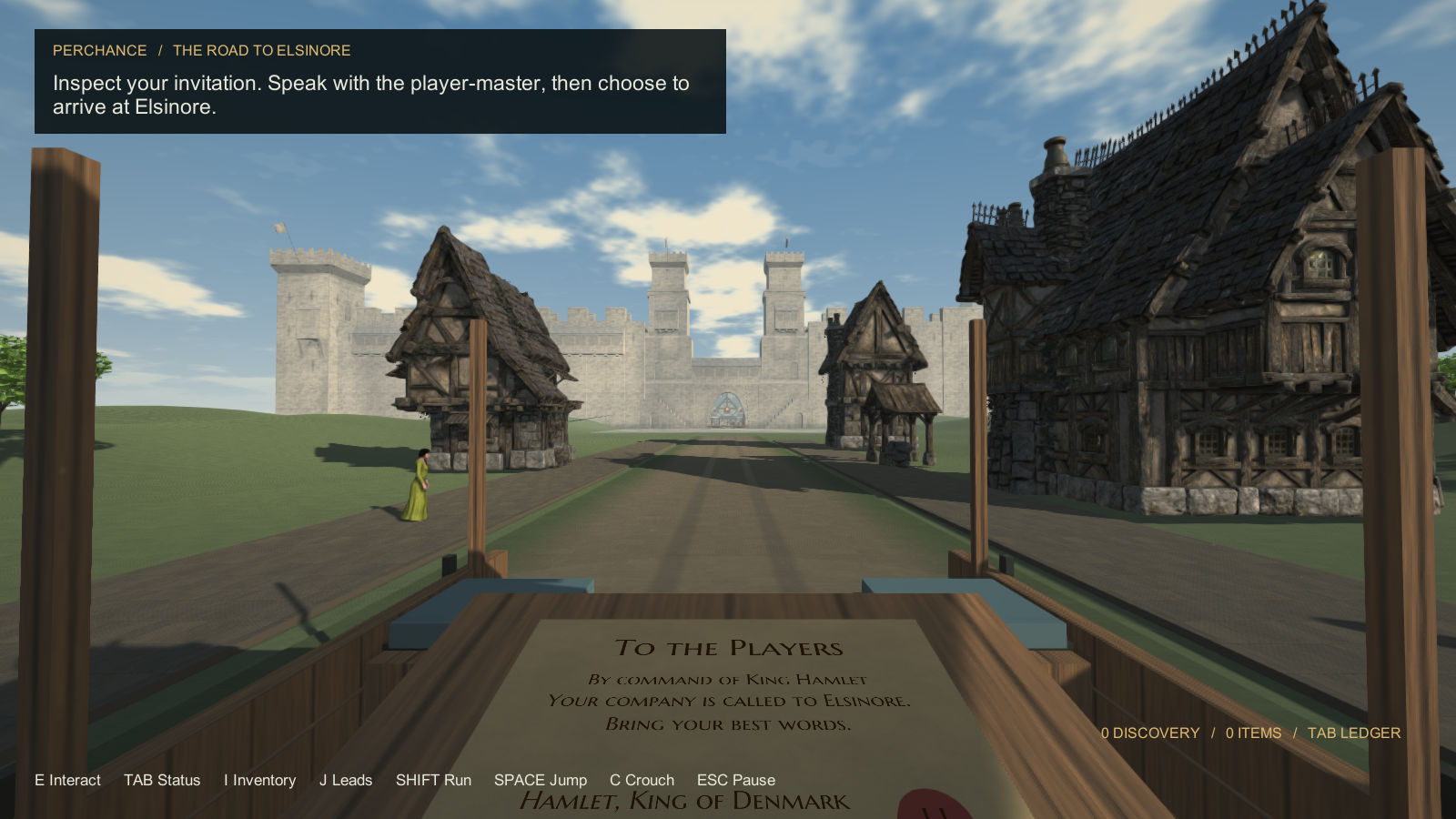
The road to Elsinore should approach a place where people live. We found an owned copy of Astrofish's Detailed Medieval Village in the original Unity test project. Timber houses, stone foundations and small shelters now frame the company wagon. The invitation still carries the old king's name; the first solid news still waits at the gates.
Players can look along the street or turn back to the invitation. Birds, quiet work sounds and anonymous townspeople give the buildings human scale. Scenery pauses while the company speaks and eases to a stop instead of endlessly recycling houses. Arrival remains the player's decision. This establishes the setting; the houses are not yet enterable destinations.
We selected a group of buildings, combined their meshes by material, retained two detail levels and capped texture resolution. The supplier originals stay intact. The newer package targets newer Unity versions, so it remains a separate migration decision. The village guide records implementation and limits; the account catalogue records the user's 71 assets. The crafting animation pack is a promising next download for everyday work, but it is not integrated in this release.
18 October 2026 — Carrying the project forward
The development workspace now has a verified copy on the R: SSD, with the G: original retained as a fallback. All 105,980 file paths and sizes matched, selected source/build/archive hashes matched, and the copied player passed a short hidden chapter-menu check. The game remains at 5.47.0; this transfer is not another gameplay release.
The development handoff preserves the conversation's creative direction: an entertaining first-person investigation for students entering Hamlet, with learning carried by choices, performance, action and the life of Elsinore. It separates the implemented baseline from recurring review targets and future ambitions. It also records that the latest voices still need listener feedback and that the exported trailers retain earlier performances. New work should start in R:, preserve the fallback and keep validation focused.
18 October 2026 — Two ceremonies, one cloth (5.49.0)
A newcomer needs enough context to care about the welcome before being asked to perform it. Shakespeare now joins the opening as a visible guide, using the original model recovered from the supplied assets. He speaks outside the play, offering three substantial introductions that players can advance, replay or leave. They explain why a prince might not inherit automatically, why Wittenberg matters, and why the marriage can hurt Hamlet as deeply as the loss it follows.
The writing leaves room for interpretation. We do not know the prince's exact location at the instant his father died. We cannot read Gertrude's mind through her son's anger. Our performance gives the marriage special weight, while letting students hear that this is a choice a production makes.
The welcome itself becomes a little theatre inside the game. After physically placing the crown and holding the silence, the actor imagines wedding linen lifting to expose mourning black. Light and rhythm change. Players choose which image to consider: the cloth, the empty place or the royal couple. Then the living household interrupts and needs an answer. The spectacle asks a question; it does not secretly award evidence of a crime.
The opening-context guide records sources, controls, source-asset provenance and the boundary between the play and our adaptation. Seventeen new recordings connect the image to the idea. Current package verification remains focused on the new flow; older trailer exports are unchanged.